Sunday, 5 June 2022

Blakespotting


Visitors to the Tate Britain William Blake exhibition of 11 September 2019—2 February 2020, were met by a sign reading

CONTENT WARNING

The art of William Blake contains
strong and sometimes challenging
imagery, including some depictions
of violence and suffering.

Please ask a member of the staff if
you would like more information.

I thought this a reasonable warning to any parent taking a child to the exhibition. But a handful of journalists reporting on the exhibition tried to make hay out of this sign, claiming that it was tantamount to censoring Blake, seemingly unaware of Blake’s Stedman engravings and the horrors they depict in such careful detail.

Wednesday, 26 January 2022

“Inoculation should be common everywhere”

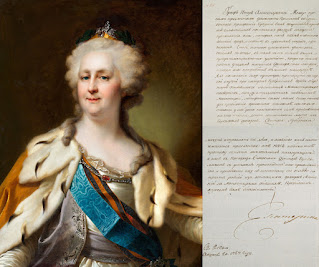
MacDougall Arts, “Important Russian Art”, auction sale 1 December 2021. Lot 14: “Portrait of the Empress Catherine the Great by Dmitry Levitsky, with Letter from Catherine the Great to Count Piotr Aleksandrovich Rumiantsev on vaccination [sic] against smallpox, 20 April 1787”.

Just over a month ago, on 1st December 2021, MacDougall Arts, of St. James's Square, held one of their regular sales of Russian works of art. Included in the auction was a portrait of Catherine II, Empress of all the Russias, otherwise Catherine the Great, by Dmitry Levitsky (1735-1822), together with a letter from Catherine to Count Piotr Aleksandrovich Rumiantsev outlining her inoculation strategy against smallpox. (The two items together sold for £951,000, if that’s of any interest.) This sale was the impetus or trigger for a talk I gave to the Blake Society AGM (19 January 2022). The title I gave it : “Inoculation should be common Everywhere”, derives from this  letter by Catherine the Great.

Sunday, 21 November 2021

Milton: titlepage or frontispiece

The Blake Society Zoom meeting of October 15, 2021, was devoted to MILTON AND THE COTTAGE. The following notes are a response to the first part of the discussion and are concerned with the titlepage (some think of it as a frontispiece; it has elements of both) to Blake’s Milton a Poem in 2 Books (1804).


Milton plate 1; copy A, British Museum.

Plate 1 of Milton presents a nude man, the spiritual form of the poet John Milton, against a background of smoke and flames. In copy A, the vortex of billowing smoke is clearly shown emerging from Milton’s left palm and, to a lesser extent, from his right wrist. (It is not so obvious in some later impressions; and is ignored by many commentators.) At the bottom is Milton’s motto from Paradise Lost: To Justify the Ways of God to Men.

Friday, 5 November 2021

Blake's Cottage at Felpham

The Blake Society’s Zoom meeting on Wednesday 20 October was devoted to MILTON AND THE COTTAGE. This is my belated response.

The climactic moment of Blake’s Milton is precipitated when the female figure Ololon appears as “a Virgin of twelve years.”

For Ololon step'd into the Polypus within the Mundane Shell
They could not step into Vegetable Worlds without becoming
The enemies of Humanity except in a Female Form
And as One Female, Ololon and all its mighty Hosts
Appear'd: a Virgin of twelve years

Ololon is the spiritual form of Milton’s Sixfold Emanation; she is the truth underlying his errors about woman. And there’s that striking designation of Ololon as “a Virgin of twelve years,” with its Biblical resonance and its evocation of the Virgin Mary. Ololon, like Mary, is a bearer of deliverance.


Wednesday, 26 May 2021

Benjamin Heath Malkin, 1769-1842 : a Bio-Bibliography.

PREFATORY NOTE

This “bio-bibliography”—a chronology of principal events in Malkin’s life and incorporating a list of his publications—was prepared many years ago for an abortive web project. It is presented here with additions and amendments, but remains a work in progress.

Benjamin Heath Malkin, antiquary and author, born in London in 1769, was headmaster of King Edward's School, Bury St Edmunds for many years, and later, more briefly, Professor of History at London University. He lived part of each year in Cowbridge, his wife’s home in the Vale of Glamorgan, from where he pursued his interests in local history and topography, and died there in 1842.

G.E. Bentley Jr. suggests that Malkin made the acquaintance of William Blake in 1803, soon after Blake returned to London from his three years in Felpham. But it is also possible that the two men were previously acquainted through the publisher Joseph Johnson for whom Blake had worked. William Godwin reports meeting Malkin at dinner at Horne Tooke’s in 1796 and 1797 and at Fuseli’s Milton Gallery in 1800, which suggests that Blake and Malkin may have shared some political and artistic sympathies. Malkin also lived close to Blake’s patron Thomas Butts in Hackney, and knew George Cumberland, another friend.

Monday, 29 March 2021

William Blake’s Cat

Mary Ann Linnell, wife to John Linnell and mother-in-law to Samuel Palmer, recalled in a letter of 1839 that “Mr Blake … used to say how much he preferred a cat to a dog as a companion because she was so much more quiet in her expression of attachment”.

It was perhaps in vague recollection of Mrs Linnell’s words that Tim Heath, two weeks ago, just before the Blake Society Zoom meeting, asked me if the Blakes, Catherine and William, ever had a cat. The answer is yes.

The Blakes moved to a cottage at Felpham in Sussex in September 1800 where Blake could work under the often burdensome patronage of the wealthy writer William Hayley. There he made the acquaintance of Hayley’s friend John Marsh (1752-1828) of Chichester, attorney, musician, prolific gentleman composer (thirty-nine symphonies), and diarist. Marsh recorded most of his long life in minute detail, in a journal that survives in thirty-seven volumes at the Huntington Library, San Marino, California.

In his Journal for 5 April 1802, Marsh wrote: “On Monday the 5th our white Cat produced 4 white Kittens, one of which we saved for Mr Blake of Felpham (Mr Hayley’s friend) but had great difficulty in rearing it, the Cat seeming to have very little Milk—”, and then repeated in his marginal summary: “Bred a White Kitten for Mr Blake”. It is pleasant to picture the white kitten playing with Catherine’s embroidery wool, or William, sitting quietly for once, dozing with a white kitten on his lap. (My understanding is that the gene that causes cats to have completely white fur is also linked to congenital hearing impairment. White cats with blue eyes are commonly deaf. One hopes that the Blakes’ white kitten escaped that disability.) Marsh’s journal also reports visits to Blake on 9th May and 26th June 1801, and gifts of white kittens to others in December 1801. Three years later, on 22th May 1805, he wrote again: “We drove to Felpham & carried our little white kitten to Mr Hayley”.

Saturday, 7 November 2020

Geoffrey Keynes: Personal Papers and Correspondence

I have recently rediscovered notes that I made decades ago of the Keynes papers in Cambridge University Library. They will be of interest to a quite limited number of people, but perhaps contain hints for future blog postings.
    When I visited Cambridge in 1992, my research interests were very much focused on William Muir (1846-1938), facsimilist, and the Blake Press at Edmonton. (Keynes had met Muir as well as purchasing some of his facsimiles through Quaritch, bookseller.) I was also acquainted with Ruth Lockwood (1914-2004), formerly Ruth Jasper, who had been Keynes’s theatre sister at Barts, so there was an additional sentimental interest.
    In 1992, the contents were still in the corrugated cardboard boxes presumably used to move them from Lammas House, the Keynes residence near Newmarket. It looked to me like the family had just popped round to the Newmarket Tesco for any spare grocery boxes.


Geoffrey Keynes, Donald Fraser and a staff nurse (probably Ruth Jasper), c. 1935.The group are pictured at the foot of a patient's bed (patient not visible) in an unidentified ward. 
(Barts Archive, Photograph Collection: SBHX8/1757.)