Sunday, 5 June 2022
William Blake and smallpox : the disease in Blake’s London and in Blake’s art
Smallpox was the single most lethal disease in eighteenth-century Britain, accounting for more deaths than any other infectious disease, even plague and cholera. In London, Europe’s largest city by 1700, smallpox increased from 4-6% of all burials in the mid-seventeenth century to over 10% in the third quarter of the eighteenth century, and the frequency of epidemics increased from roughly four-yearly to a biennial cycle over the same period.
Smallpox was an acute, highly contagious, and frequently fatal disease (killing one-seventh to one-quarter of its victims) but conferring lifelong immunity on survivors. It appeared initially as an infrequent epidemic disease affecting all ages, but as the frequency of epidemics increased, a growing proportion of the adult population acquired immunity to the disease, and smallpox was clearly a childhood disease in the London-born population of the eighteenth century, with children under five the main victims. Among those who survived it, morbidity from smallpox was severe in many cases; victims could be left blind or disfigured for life. Few native Londoners would have survived to adulthood without encountering smallpox.
[Indeed, are there any depictions of smallpox in Blake’s work?]
William Hayley and Smallpox
William Hayley (1745-1820) is remembered today chiefly as the much-derided Felpham Billy, the Bard of Sussex, the friend or enemy of William Blake. But he was a generous and effective patron and friend to Cowper, Romney, Flaxman, and Blake, as well as many others; and it is perhaps unjust that his name should chiefly live in the spiky epigrams which Blake jotted down in his notebook
Thy Friendship oft has made my heart to ake
Do be my Enemy for Friendships sake.
In his lifetime, Hayley was an acclaimed poet, a scholar who achieved both commercial and critical success before, towards the end of his life, his work fell out of fashion. He was the first person to publish a substantial extract of Dante’s Divine Comedy in English translation, declined the offer of the poet laureateship (partly for political reasons), and, in his biographical writings, often explored issues of mental health. His literary efforts extended to drama, biographies of Milton and Cowper, an essay on sculpture, and endless epitaphs (many of them accompanying monuments in Chichester cathedral). He was also an amateur physician, treating himself, his household, and the villagers of Felpham with the then-fashionable electrical cure.
Despite having written a bestselling and highly influential book advising young women on how to attract and keep a husband (The Triumphs of Temper, 1781, and innumerable subsequent editions), Hayley’s own romantic life was a failure, with two disastrous marriages.
Blakespotting
Visitors to the Tate Britain William Blake exhibition of 11 September 2019—2 February 2020, were met by a sign reading
CONTENT WARNING
The art of William Blake containsstrong and sometimes challengingimagery, including some depictionsof violence and suffering.
Please ask a member of the staff ifyou would like more information.
I thought this a reasonable warning to any parent taking a child to the exhibition. But a handful of journalists reporting on the exhibition tried to make hay out of this sign, claiming that it was tantamount to censoring Blake, seemingly unaware of Blake’s Stedman engravings and the horrors they depict in such careful detail.
Wednesday, 26 January 2022
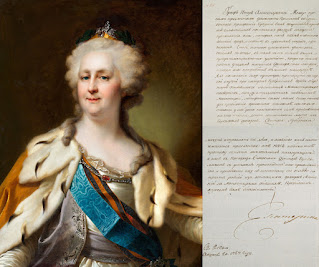
“Inoculation should be common everywhere”
MacDougall Arts, “Important Russian Art”, auction sale 1 December 2021. Lot 14: “Portrait of the Empress Catherine the Great by Dmitry Levitsky, with Letter from Catherine the Great to Count Piotr Aleksandrovich Rumiantsev on vaccination [sic] against smallpox, 20 April 1787”.
Just over a month ago, on 1st December 2021, MacDougall Arts, of St. James's Square, held one of their regular sales of Russian works of art. Included in the auction was a portrait of Catherine II, Empress of all the Russias, otherwise Catherine the Great, by Dmitry Levitsky (1735-1822), together with a letter from Catherine to Count Piotr Aleksandrovich Rumiantsev outlining her inoculation strategy against smallpox. (The two items together sold for £951,000, if that’s of any interest.) This sale was the impetus or trigger for a talk I gave to the Blake Society AGM (19 January 2022). The title I gave it : “Inoculation should be common Everywhere”, derives from this letter by Catherine the Great.
Sunday, 21 November 2021
Milton: titlepage or frontispiece
The Blake Society Zoom meeting of October 15, 2021, was devoted to MILTON AND THE COTTAGE. The following notes are a response to the first part of the discussion and are concerned with the titlepage (some think of it as a frontispiece; it has elements of both) to Blake’s Milton a Poem in 2 Books (1804).
Plate 1 of Milton presents a nude man, the spiritual form of the poet John Milton, against a background of smoke and flames. In copy A, the vortex of billowing smoke is clearly shown emerging from Milton’s left palm and, to a lesser extent, from his right wrist. (It is not so obvious in some later impressions; and is ignored by many commentators.) At the bottom is Milton’s motto from Paradise Lost: To Justify the Ways of God to Men.
Milton plate 1; copy A, British Museum.
Plate 1 of Milton presents a nude man, the spiritual form of the poet John Milton, against a background of smoke and flames. In copy A, the vortex of billowing smoke is clearly shown emerging from Milton’s left palm and, to a lesser extent, from his right wrist. (It is not so obvious in some later impressions; and is ignored by many commentators.) At the bottom is Milton’s motto from Paradise Lost: To Justify the Ways of God to Men.
Friday, 5 November 2021
Blake's Cottage at Felpham
The Blake Society’s Zoom meeting on Wednesday 20 October was devoted to MILTON AND THE COTTAGE. This is my belated response.
The climactic moment of Blake’s Milton is precipitated when the female figure Ololon appears as “a Virgin of twelve years.”
Ololon is the spiritual form of Milton’s Sixfold Emanation; she is the truth underlying his errors about woman. And there’s that striking designation of Ololon as “a Virgin of twelve years,” with its Biblical resonance and its evocation of the Virgin Mary. Ololon, like Mary, is a bearer of deliverance.
The climactic moment of Blake’s Milton is precipitated when the female figure Ololon appears as “a Virgin of twelve years.”
For Ololon step'd into the Polypus within the Mundane Shell
They could not step into Vegetable Worlds without becoming
The enemies of Humanity except in a Female Form
And as One Female, Ololon and all its mighty Hosts
Appear'd: a Virgin of twelve years
Ololon is the spiritual form of Milton’s Sixfold Emanation; she is the truth underlying his errors about woman. And there’s that striking designation of Ololon as “a Virgin of twelve years,” with its Biblical resonance and its evocation of the Virgin Mary. Ololon, like Mary, is a bearer of deliverance.
Wednesday, 26 May 2021
Benjamin Heath Malkin, 1769-1842 : a Bio-Bibliography.
PREFATORY NOTE
This “bio-bibliography”—a chronology of principal events in Malkin’s life and incorporating a list of his publications—was prepared many years ago for an abortive web project. It is presented here with additions and amendments, but remains a work in progress.
Benjamin Heath Malkin, antiquary and author, born in London in 1769, was headmaster of King Edward's School, Bury St Edmunds for many years, and later, more briefly, Professor of History at London University. He lived part of each year in Cowbridge, his wife’s home in the Vale of Glamorgan, from where he pursued his interests in local history and topography, and died there in 1842.
G.E. Bentley Jr. suggests that Malkin made the acquaintance of William Blake in 1803, soon after Blake returned to London from his three years in Felpham. But it is also possible that the two men were previously acquainted through the publisher Joseph Johnson for whom Blake had worked. William Godwin reports meeting Malkin at dinner at Horne Tooke’s in 1796 and 1797 and at Fuseli’s Milton Gallery in 1800, which suggests that Blake and Malkin may have shared some political and artistic sympathies. Malkin also lived close to Blake’s patron Thomas Butts in Hackney, and knew George Cumberland, another friend.
This “bio-bibliography”—a chronology of principal events in Malkin’s life and incorporating a list of his publications—was prepared many years ago for an abortive web project. It is presented here with additions and amendments, but remains a work in progress.
Benjamin Heath Malkin, antiquary and author, born in London in 1769, was headmaster of King Edward's School, Bury St Edmunds for many years, and later, more briefly, Professor of History at London University. He lived part of each year in Cowbridge, his wife’s home in the Vale of Glamorgan, from where he pursued his interests in local history and topography, and died there in 1842.
G.E. Bentley Jr. suggests that Malkin made the acquaintance of William Blake in 1803, soon after Blake returned to London from his three years in Felpham. But it is also possible that the two men were previously acquainted through the publisher Joseph Johnson for whom Blake had worked. William Godwin reports meeting Malkin at dinner at Horne Tooke’s in 1796 and 1797 and at Fuseli’s Milton Gallery in 1800, which suggests that Blake and Malkin may have shared some political and artistic sympathies. Malkin also lived close to Blake’s patron Thomas Butts in Hackney, and knew George Cumberland, another friend.
Subscribe to:
Posts (Atom)