Showing posts with label William Blake. Show all posts

Wednesday, 18 February 2026

Richard Gough: scholar, antiquary and man of violence

The British Antiquities are now in the Artist’s hands; all his visionary contemplations, relating to his own country and its ancient glory, when it was as it again shall be, the source of learning and inspiration.—WILLIAM BLAKE(1)

During the latter half of the eighteenth century, interest in antiquities developed into the common pursuit of the educated man: Bishop Thomas Percy was collecting his Reliques; Thomas Warton collecting materials for histories of Winchester and of Kidlington, writing a history of English poetry, and exposing the forgeries attributed to Thomas Rowley; John Sherwen collecting materials to establish the authenticity of the Rowley poems; Horace Walpole assembling a catalogue of the works of royal and noble authors; John Nichols preparing his monumental history of Leicestershire; Joseph Ritson contributing to the creation of a real scholarly study of folk song and the ballad tradition; Francis Douce reviving interest in village traditions such as games and mummers' plays; and all of these men, along with almost everyone who was doing any writing at all, were looking up information for each other, copying inscriptions, collecting anecdotes, and writing innumerable letters.(2)

Blake scholars have long been engaged in an illuminating discussion of the way Blake and the other Romantics used in their works the often wonderfully perverse conclusions of contemporary antiquaries and mythologists such as Stukeley, Bryant, and the rest.(3) My concern here is with the intersection of Blake’s life and work with that of a more sober figure, Richard Gough. Gough’s life is exceptionally well-documented. And some details of Gough’s life can illumine that of the obscurer William Blake.

Friday, 29 November 2024

Good morning, Doctor Haydn

 
In a recent Global Blake event, a symposium, Blake and Music, on the musical reception of William Blake, Camila Oliveira gave a paper “William Blake & Visionary Cover Arts”, that drew attention to the use of Blake’s images on the covers of classical recordings. Of note was the fondness of record companies to use Blake for recordings of works by Haydn, even when there was no obvious link between the composer’s work and William Blake himself.

Tuesday, 26 March 2024

“O Nancy’s hair is yellow as gowd”: Blake, Border ballads, and the reinvention of relief etching

In a prospectus addressed To the Public, and dated 10 October 1793, William Blake described his invention of “illuminated printing” in these words:
The Labours of the Artist, the Poet, the Musician, have been proverbially attended by poverty and obscurity; this was never the fault of the Public, but was owing to a neglect of means to propagate such works as have wholly absorbed the Man of Genius. Even Milton and Shakespeare could not publish their own works.
    This difficulty has been obviated by the Author of the following productions now presented to the Public, who has invented a method of printing both Letter-press and Engraving in a style more ornamental, uniform, and grand, than any before discovered, while it produces works at less than one-fourth the expense.
    If a method of Printing which combines the Painter and Poet is a phenomenon worthy of public attention, provided that it exceeds in elegance all former methods, the Author is sure of his reward. (E 692; see NOTE at end.)

Wednesday, 23 August 2023

Another Engraver in South Molton Street

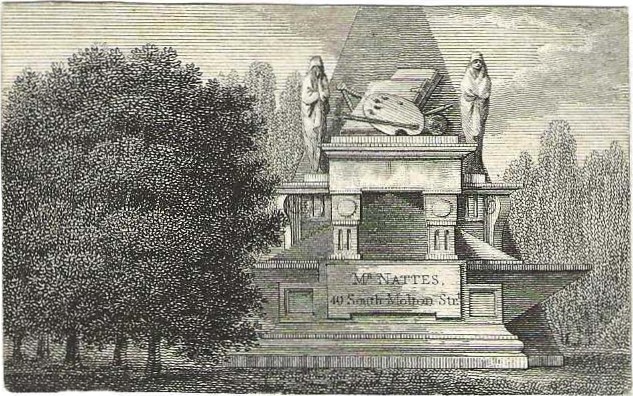
I recently purchased the engraved trade-card of John Claude Nattes, (c 1765-1839), topographical draughtsman, drawing master, print dealer, and occasional print-maker, who lived in South Molton Street from c 1787 to some time after 1795. The card  shows a monument with two hooded figures on top flanking a group of art-related objects including a palette and brushes, a pyramid behind; trees in the foreground to the left. The plinth of the monument is inscribed "Mr Nattes, 49 South Molton Strt.".


The card has been trimmed to the image  (50 x 79 mm.) but other copies now in the British Museum supply an imprint: "C.N. [i.e. Claude Nattes] del.    W. Angus sc.".

Thursday, 17 August 2023

The Whore Next Door: William Blake’s Neighbours in South Molton Street.

I write in South Molton Street, what I both see and hear
In regions of Humanity, in Londons opening streets.
William Blake, Jerusalem (E 180)


In September 1803, after an absence of three years in the coastal village of Felpham in Sussex, William and Catherine Blake returned to London. Initially they lodged with William's brother and sister, James and Catherine Elizabeth Blake, at 28 Broad Street, later Broadwick Street, Carnaby Market. Less than a month later, William and Catherine moved into a two-room flat on the first floor of 17 South Molton Street, off Oxford Street. During their 17 years of residence there, the Blakes printed and coloured their most ambitious illuminated books.

The house was shared with their landlords, successively the tailor William Enoch (c 1803-4) and his family, and the staymaker Mark Martin (c 1805-21), his wife Eleanor and their family. There were presumably other lodgers on the upper floors.

In 1958 the Westminster voters’ list records the following persons as resident at 17 South Molton Street: Ida Golz, Anthony S. Gotlop, Frank Holland, Leah Laden, Minnie Sandground, and Stanley V. Sandground. I believe at this time the residents occupied cold-water flats on the upper floors, with commercial premises on the ground floor and basement.

Sunday, 5 June 2022

William Blake and smallpox : the disease in Blake’s London and in Blake’s art

Smallpox was the single most lethal disease in eighteenth-century Britain, accounting for more deaths than any other infectious disease, even plague and cholera. In London, Europe’s largest city by 1700, smallpox increased from 4-6% of all burials in the mid-seventeenth century to over 10% in the third quarter of the eighteenth century, and the frequency of epidemics increased from roughly four-yearly to a biennial cycle over the same period.

Smallpox was an acute, highly contagious, and frequently fatal disease (killing one-seventh to one-quarter of its victims) but conferring lifelong immunity on survivors. It appeared initially as an infrequent epidemic disease affecting all ages, but as the frequency of epidemics increased, a growing proportion of the adult population acquired immunity to the disease, and smallpox was clearly a childhood disease in the London-born population of the eighteenth century, with children under five the main victims. Among those who survived it, morbidity from smallpox was severe in many cases; victims could be left blind or disfigured for life. Few native Londoners would have survived to adulthood without encountering smallpox.

[Indeed, are there any depictions of smallpox in Blake’s work?]

William Hayley and Smallpox

William Hayley (1745-1820) is remembered today chiefly as the much-derided Felpham Billy, the Bard of Sussex, the friend or enemy of William Blake. But he was a generous and effective patron and friend to Cowper, Romney, Flaxman, and Blake, as well as many others; and it is perhaps unjust that his name should chiefly live in the spiky epigrams which Blake jotted down in his notebook

Thy Friendship oft has made my heart to ake
Do be my Enemy for Friendships sake.

In his lifetime, Hayley was an acclaimed poet, a scholar who achieved both commercial and critical success before, towards the end of his life, his work fell out of fashion. He was the first person to publish a substantial extract of Dante’s Divine Comedy in English translation, declined the offer of the poet laureateship (partly for political reasons), and, in his biographical writings, often explored issues of mental health. His literary efforts extended to drama, biographies of Milton and Cowper, an essay on sculpture, and endless epitaphs (many of them accompanying monuments in Chichester cathedral). He was also an amateur physician, treating himself, his household, and the villagers of Felpham with the then-fashionable electrical cure.

Despite having written a bestselling and highly influential book advising young women on how to attract and keep a husband (The Triumphs of Temper, 1781, and innumerable subsequent editions), Hayley’s own romantic life was a failure, with two disastrous marriages.

Blakespotting


Visitors to the Tate Britain William Blake exhibition of 11 September 2019—2 February 2020, were met by a sign reading

CONTENT WARNING

The art of William Blake contains
strong and sometimes challenging
imagery, including some depictions
of violence and suffering.

Please ask a member of the staff if
you would like more information.

I thought this a reasonable warning to any parent taking a child to the exhibition. But a handful of journalists reporting on the exhibition tried to make hay out of this sign, claiming that it was tantamount to censoring Blake, seemingly unaware of Blake’s Stedman engravings and the horrors they depict in such careful detail.

Wednesday, 26 January 2022

“Inoculation should be common everywhere”

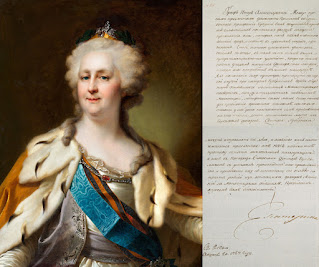
MacDougall Arts, “Important Russian Art”, auction sale 1 December 2021. Lot 14: “Portrait of the Empress Catherine the Great by Dmitry Levitsky, with Letter from Catherine the Great to Count Piotr Aleksandrovich Rumiantsev on vaccination [sic] against smallpox, 20 April 1787”.

Just over a month ago, on 1st December 2021, MacDougall Arts, of St. James's Square, held one of their regular sales of Russian works of art. Included in the auction was a portrait of Catherine II, Empress of all the Russias, otherwise Catherine the Great, by Dmitry Levitsky (1735-1822), together with a letter from Catherine to Count Piotr Aleksandrovich Rumiantsev outlining her inoculation strategy against smallpox. (The two items together sold for £951,000, if that’s of any interest.) This sale was the impetus or trigger for a talk I gave to the Blake Society AGM (19 January 2022). The title I gave it : “Inoculation should be common Everywhere”, derives from this  letter by Catherine the Great.

Sunday, 21 November 2021

Milton: titlepage or frontispiece

The Blake Society Zoom meeting of October 15, 2021, was devoted to MILTON AND THE COTTAGE. The following notes are a response to the first part of the discussion and are concerned with the titlepage (some think of it as a frontispiece; it has elements of both) to Blake’s Milton a Poem in 2 Books (1804).


Milton plate 1; copy A, British Museum.

Plate 1 of Milton presents a nude man, the spiritual form of the poet John Milton, against a background of smoke and flames. In copy A, the vortex of billowing smoke is clearly shown emerging from Milton’s left palm and, to a lesser extent, from his right wrist. (It is not so obvious in some later impressions; and is ignored by many commentators.) At the bottom is Milton’s motto from Paradise Lost: To Justify the Ways of God to Men.

Friday, 5 November 2021

Blake's Cottage at Felpham

The Blake Society’s Zoom meeting on Wednesday 20 October was devoted to MILTON AND THE COTTAGE. This is my belated response.

The climactic moment of Blake’s Milton is precipitated when the female figure Ololon appears as “a Virgin of twelve years.”

For Ololon step'd into the Polypus within the Mundane Shell
They could not step into Vegetable Worlds without becoming
The enemies of Humanity except in a Female Form
And as One Female, Ololon and all its mighty Hosts
Appear'd: a Virgin of twelve years

Ololon is the spiritual form of Milton’s Sixfold Emanation; she is the truth underlying his errors about woman. And there’s that striking designation of Ololon as “a Virgin of twelve years,” with its Biblical resonance and its evocation of the Virgin Mary. Ololon, like Mary, is a bearer of deliverance.


Wednesday, 26 May 2021

Benjamin Heath Malkin, 1769-1842 : a Bio-Bibliography.

PREFATORY NOTE

This “bio-bibliography”—a chronology of principal events in Malkin’s life and incorporating a list of his publications—was prepared many years ago for an abortive web project. It is presented here with additions and amendments, but remains a work in progress.

Benjamin Heath Malkin, antiquary and author, born in London in 1769, was headmaster of King Edward's School, Bury St Edmunds for many years, and later, more briefly, Professor of History at London University. He lived part of each year in Cowbridge, his wife’s home in the Vale of Glamorgan, from where he pursued his interests in local history and topography, and died there in 1842.

G.E. Bentley Jr. suggests that Malkin made the acquaintance of William Blake in 1803, soon after Blake returned to London from his three years in Felpham. But it is also possible that the two men were previously acquainted through the publisher Joseph Johnson for whom Blake had worked. William Godwin reports meeting Malkin at dinner at Horne Tooke’s in 1796 and 1797 and at Fuseli’s Milton Gallery in 1800, which suggests that Blake and Malkin may have shared some political and artistic sympathies. Malkin also lived close to Blake’s patron Thomas Butts in Hackney, and knew George Cumberland, another friend.

Monday, 29 March 2021

William Blake’s Cat

Mary Ann Linnell, wife to John Linnell and mother-in-law to Samuel Palmer, recalled in a letter of 1839 that “Mr Blake … used to say how much he preferred a cat to a dog as a companion because she was so much more quiet in her expression of attachment”.

It was perhaps in vague recollection of Mrs Linnell’s words that Tim Heath, two weeks ago, just before the Blake Society Zoom meeting, asked me if the Blakes, Catherine and William, ever had a cat. The answer is yes.

The Blakes moved to a cottage at Felpham in Sussex in September 1800 where Blake could work under the often burdensome patronage of the wealthy writer William Hayley. There he made the acquaintance of Hayley’s friend John Marsh (1752-1828) of Chichester, attorney, musician, prolific gentleman composer (thirty-nine symphonies), and diarist. Marsh recorded most of his long life in minute detail, in a journal that survives in thirty-seven volumes at the Huntington Library, San Marino, California.

In his Journal for 5 April 1802, Marsh wrote: “On Monday the 5th our white Cat produced 4 white Kittens, one of which we saved for Mr Blake of Felpham (Mr Hayley’s friend) but had great difficulty in rearing it, the Cat seeming to have very little Milk—”, and then repeated in his marginal summary: “Bred a White Kitten for Mr Blake”. It is pleasant to picture the white kitten playing with Catherine’s embroidery wool, or William, sitting quietly for once, dozing with a white kitten on his lap. (My understanding is that the gene that causes cats to have completely white fur is also linked to congenital hearing impairment. White cats with blue eyes are commonly deaf. One hopes that the Blakes’ white kitten escaped that disability.) Marsh’s journal also reports visits to Blake on 9th May and 26th June 1801, and gifts of white kittens to others in December 1801. Three years later, on 22th May 1805, he wrote again: “We drove to Felpham & carried our little white kitten to Mr Hayley”.

Saturday, 7 November 2020

Geoffrey Keynes: Personal Papers and Correspondence

I have recently rediscovered notes that I made decades ago of the Keynes papers in Cambridge University Library. They will be of interest to a quite limited number of people, but perhaps contain hints for future blog postings.
    When I visited Cambridge in 1992, my research interests were very much focused on William Muir (1846-1938), facsimilist, and the Blake Press at Edmonton. (Keynes had met Muir as well as purchasing some of his facsimiles through Quaritch, bookseller.) I was also acquainted with Ruth Lockwood (1914-2004), formerly Ruth Jasper, who had been Keynes’s theatre sister at Barts, so there was an additional sentimental interest.
    In 1992, the contents were still in the corrugated cardboard boxes presumably used to move them from Lammas House, the Keynes residence near Newmarket. It looked to me like the family had just popped round to the Newmarket Tesco for any spare grocery boxes.


Geoffrey Keynes, Donald Fraser and a staff nurse (probably Ruth Jasper), c. 1935.The group are pictured at the foot of a patient's bed (patient not visible) in an unidentified ward. 
(Barts Archive, Photograph Collection: SBHX8/1757.)

Saturday, 10 October 2020

William Blake and Hampstead


“Old Wyldes”, North End, where the painter John Linnell played host to William Blake, is an early 17th-century house on the edge of Hampstead Heath. Though the present house was probably built soon after 1600, the estate of which it was the farmhouse was very much older, dating back to medieval times when it had been under monastic control. Wyldes was the medieval name of the estate, a name that was revived at the end of the 19th century. In Blake’s day it was known as Collins Farm.

The Collinses, father and son (and both called John) had been farming Wyldes since 1793. John Collins, the younger, was a small scale dairy farmer, owning 16 cows which grazed on the heath. He also sold strawberries, apples, currants and fresh water at a penny farthing a pail from one of the wells near the house. It is said that “J. Collins cow Keeper & Dairyman North End” can still be seen scratched on the window of his kitchen.

Thursday, 24 September 2020

The Chamber on the Wall

2 KINGS 4: 8-11 (King James Version)
8 And it fell on a day, that Elisha passed to Shunem, where was a great woman; and she constrained him to eat bread. And so it was, that as oft as he passed by, he turned in thither to eat bread.
9 And she said unto her husband, Behold now, I perceive that this is an holy man of God, which passeth by us continually.
10 Let us make a little chamber, I pray thee, on the wall; and let us set for him there a bed, and a table, and a stool, and a candlestick: and it shall be, when he cometh to us, that he shall turn in thither.
11 And it fell on a day, that he came thither, and he turned into the chamber, and lay there.

2 KÖNIGE 4: 8-11 (Luther Bibel 1545)

8 Und es begab sich zu der Zeit, daß Elisa ging gen Sunem. Daselbst war eine reiche Frau; die hielt ihn, daß er bei ihr aß. Und so oft er daselbst durchzog, kehrte er zu ihr ein und aß bei ihr.
9 Und sie sprach zu ihrem Mann: Siehe, ich merke, daß dieser Mann Gottes heilig ist, der immerdar hier durchgeht.
10 Laß uns ihm eine kleine bretterne Kammer oben machen und ein Bett, Tisch, Stuhl und Leuchter hineinsetzen, auf daß er, wenn er zu uns kommt, dahin sich tue.
11 Und es begab sich zu der Zeit, daß er hineinkam und legte sich oben in die Kammer und schlief darin

Monday, 14 September 2020

Bill Goldman, 1950—2020

My friend Bill Goldman died aged 70 in May this year. I have taken far longer to write these notes than I intended thanks to my continuing post-Covid 19 fatigue. I apologise now for any errors, omissions, infelicitous expressions or, indeed, lapses of tone in what follows.

William David “Bill” Goldman, Blake scholar, was born in 1950 in St Pancras, London, the first child and only son (there are two younger sisters) of Joan and William Goldman. Bill’s father, Willy, born 1910 in Mile End Old Town, was a significant memorialist of the Jewish East End. Willy Goldman married as his third wife, Mavis Joan Allsop, in St Pancras, London, in 1950.

Bill entered Sir William Borlase Grammar School in 1960, a good grammar school in Marlow, Buckinghamshire. He left aged 16 with 7 GCEs and one O/A level (Use of English, A-grade) to work for BBC Publications, sorting and delivering office mail. By 1970 he had acquired the qualifications for university entrance and went to the University of Essex to study English Literature. Bill dropped out after two years. I don’t recall him ever speaking about the period following except that it led to his religious conversion around about 1977, of which he wrote “I met Jesus my Saviour and acknowledged Him as such … I love the Bible and regard it as God’s Word as it claims to be”. (To me, this kind of talk is close to meaningless. If the Bible is God’s word, then God is a really crap mathematician. See 1 KINGS 7:23.) I can see that conversion gave Bill’s life a stability it might otherwise have lacked but I think it also made him vulnerable to the Christian flat-earthists, worshippers of Blake’s “old Nobodaddy aloft”, who were/are a feature of the Richmond church he joined.

Wednesday, 4 March 2020

The bourgeois Blake

On 29 November 2019, and coinciding with the Blake exhibition at Tate Britain, I attended “William Blake and the Idea of the Artist”, a conference at the Paul Mellon Centre in Bedford Square. The conference sought to “consider the work of William Blake with the context of Romanticism and the artistic currents of his times, the creative legacies of his work and the contemporary resonances of Blake’s vision”.

The first speaker, Silvia Riccardi (University of Freiburg), drawing attention to the interlinear squiggles and elaborations of the lettering in, for example, America, made one want to go back to the works in illuminated printing again, and this time take a magnifying glass. The speakers that followed all made similarly thoughtful contributions. But the final speaker, Dave Beech (University of the Arts, London) left me puzzled.

If I understood his argument, Beech claimed there was an eighteenth-century class distinction between “artisans”, like Blake, who had undergone an apprenticeship, and “artists”, who attended academies. Perhaps it would be anachronistic to point out that Raphael, for example, was apprenticed to Perugino; but surely not anachronistic to note that Sir Joshua Reynolds served an apprenticeship with the fashionable London portrait painter Thomas Hudson. At the age of 10 Blake was drawing from casts of antiquities in the school of Henry Pars, before his apprenticeship to James Basire in 1772. After 1779 Blake was a student at the Royal Academy, where he diligently drew from classical sculpture under the instruction of George Moser.

Wednesday, 27 November 2019

Bunhill Fields—25 May 1708


Post Boy, January 10, 1708 - January 13, 1708; Issue 1975.

In early 1708, the religious group known as the French Prophets (a millenarian movement active in London from 1706), sensationally announced in the London newspapers that Thomas Emes, one of their number, who had died at the end of December 1707, would rise from his grave at Bunhill Fields on 25 May.

Wednesday, 16 October 2019

Blakespotting: Private Eye

The Private Eye letters pages regularly include “Lookalikes” where sometimes surprising visual resemblances are brought to our attention. The issue of 4-17 October 2019 features, on pages 21-22, no fewer than three Lookalikes and a Moggalike (Jacob Rees-Mogg appropriately paired with a relaxing kangaroo).

Here’s page 22 (click to enlarge)